
What are UCAT SJT bands?
The Situational Judgement Test is the final separately timed part of the current UK UCAT. It asks you to evaluate realistic situations and choose or rank responses. The focus is professional judgement: recognising important factors, acting appropriately and understanding how your decision affects other people. It is not a test of biology, arithmetic or the speed used in the cognitive subtests.
Your result is reported as one of four UCAT SJT bands. Band 1 is the strongest category and Band 4 is the lowest category. The band is calculated from your SJT marks after full and partial credit are considered. It is deliberately separate from the cognitive total, so adding a band to VR, DM and QR would give a misleading number.
What does each UCAT SJT band mean?
The official descriptions are more useful than labels such as good or bad. They explain how often your responses matched expert or model answers, while recognising that a judgement question can have more than one plausible action. Use the wording as a performance description rather than as a promise about how a university will rank you.
| Band | Official performance idea | How to read it |
|---|---|---|
| Band 1 | Excellent; judgement similar to the expert panel in most cases. | A strong, consistently aligned result. |
| Band 2 | Good and solid; appropriate judgement shown frequently. | A common positive outcome, but still check each course policy. |
| Band 3 | Modest; some appropriate judgement with substantial differences elsewhere. | A mixed result that may need careful policy checking. |
| Band 4 | Low; judgement differs substantially from ideal responses in many cases. | A warning to review preparation and university requirements. |
How is the SJT marked, and what are partial marks?
The UCAT Consortium explains that full marks are awarded when your response matches the correct answer. Partial marks can be awarded when your response is close to the correct answer. This is why a simple correct-count percentage cannot reproduce an official SJT band. The conversion from marks to a band is based on the test's scoring rules and the cohort context, rather than a public promise that one percentage always equals one band.
Question formats can ask you to rate how appropriate an action is or how important an action is in the situation. Read the scenario first, identify the critical factor and then judge the response against professional expectations. A response that feels kind in isolation can still be inappropriate if it ignores safety, confidentiality, honesty or the need to escalate a concern.
What does the 2026 UCAT SJT distribution show?
The official UCAT Test Statistics page says its 2026 data was valid up to 24 September 2026 and covered 42,359 tests. The published SJT distribution places 15% of candidates in Band 1, 40% in Band 2, 34% in Band 3 and 11% in Band 4. These percentages describe that testing population; they are not admission probabilities and they do not define a universal pass mark.
The distribution is useful for context because Band 2 is the largest group in this snapshot. It does not mean every university treats Band 2 identically. Some courses may require a particular band, use it as a threshold, combine it with other evidence or explain that it is not used. Read the current admissions page for each course before deciding what your result means.
| 2026 SJT band | Share of candidates | Safe interpretation |
|---|---|---|
| Band 1 | 15% | Highest category in the official snapshot. |
| Band 2 | 40% | Largest category; often described as solid, but policy still varies. |
| Band 3 | 34% | A substantial group; read course rules rather than assuming rejection. |
| Band 4 | 11% | Lowest category; investigate requirements and improve future practice. |
Why your SJT band is separate from the cognitive total
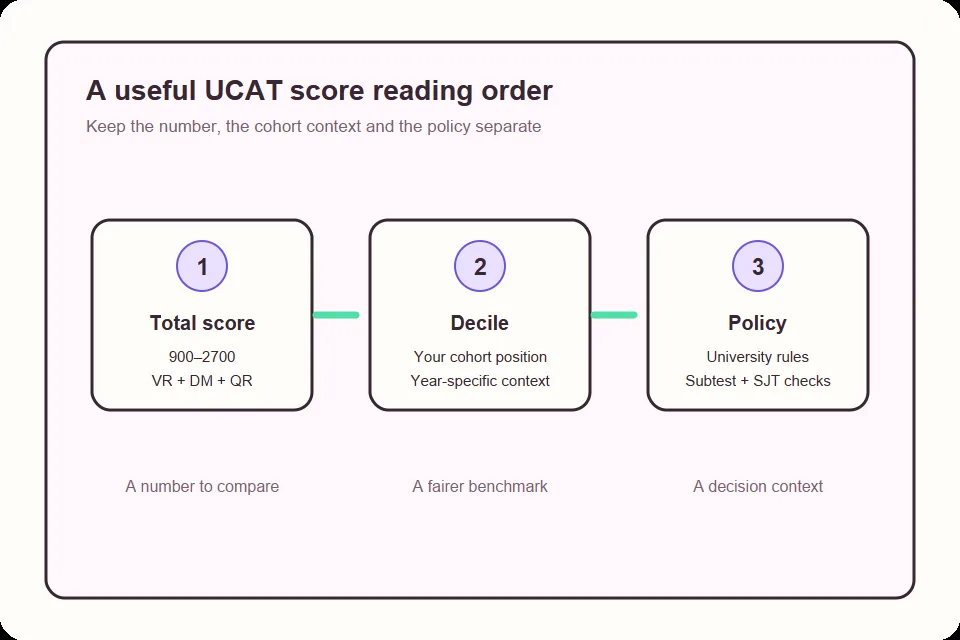
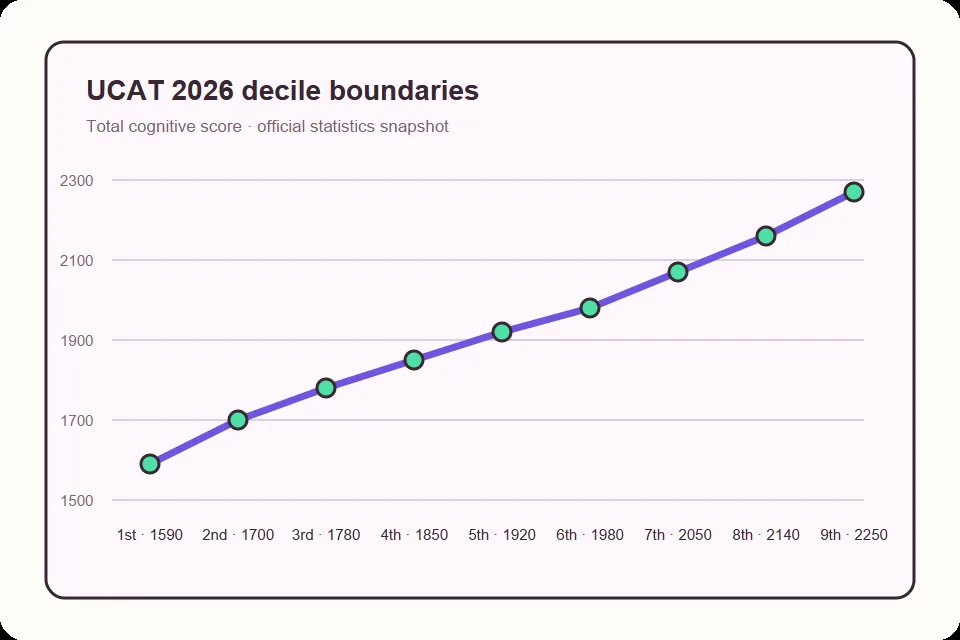
Verbal Reasoning, Decision Making and Quantitative Reasoning have scaled scores from 300 to 900. Those three values are added to create the cognitive total, which runs from 900 to 2,700. SJT is not another 300-to-900 subtest in the current UK result format. It is reported as Band 1, Band 2, Band 3 or Band 4 alongside the cognitive total.
That separation prevents an easy but incorrect comparison such as treating Band 1 as 900 points or adding Band 2 to a total of 2,100. When you review a result, write down the cognitive total, its percentile or decile context, the SJT band and the university policy as four separate lines. This makes it easier to compare courses without inventing a combined score that the official report does not provide.
How to approach UCAT SJT questions
SJT preparation is not about memorising one phrase that wins every scenario. Start by identifying who may be affected, what risk is present and whether the issue needs immediate escalation. Then compare each answer with professional behaviour: honesty, patient or colleague safety, respect, confidentiality, accountability and willingness to ask for help. The best response is often the one that addresses the problem directly while using an appropriate source of support.
Keep the scenario's facts in view. Do not add a dramatic detail that was never stated, and do not excuse an unsafe action because the person had a good intention. If two answers seem close, ask which one protects people, follows a reasonable process and deals with the concern at the right level. This reasoning is more reliable than choosing the answer that sounds most confident.
After a mock, review the reason for each disagreement. Separate a knowledge gap, a rushed reading error and a genuine judgement difference. Tracking those categories gives you a better revision plan than simply counting how many questions you missed.
Timing and a practical preparation checklist
The current UK SJT timing is 26 minutes for 69 questions. That is a tight average, so a long debate over one scenario can reduce the time available for later questions. Use the official tutorial and realistic timed practice to learn the interface, then adjust your pace after looking at accuracy. Speed is useful only when it does not turn careful reading into guessing.
Limits, common mistakes and next steps
The most common mistake is treating a UCAT SJT band as a universal admissions grade. The 2026 distribution is a national snapshot, while a medical school may use a different rule or no SJT rule at all. A second mistake is comparing a mock provider's band with an official band as though the conversion were identical. Record the source and date, and use the official UCAT site for the current definitions.
Avoid converting Band 1 to a cognitive score, adding Band 1 to your total, or using a single historical percentage as a guarantee. If your band worries you, check the universities you are considering, identify the behaviours behind missed questions and practise with a reliable explanation of the current format. The goal is a better decision process, not a decorative label on a spreadsheet.
Common questions
UCAT SJT bands FAQ
What is the highest UCAT SJT band?
Band 1 is the highest UCAT SJT band. Band 2, Band 3 and Band 4 follow in that order, with Band 4 the lowest category.
Is Band 2 a good UCAT SJT result?
Band 2 is described by the UCAT Consortium as a good, solid level of performance and it was the largest group in the 2026 distribution. Whether it is acceptable for an application depends on the current policy of each university and course.
Does SJT count toward the UCAT cognitive total?
No. The cognitive total adds the scaled scores for Verbal Reasoning, Decision Making and Quantitative Reasoning. SJT is reported separately as Band 1 to Band 4.
How long is the SJT section of the UCAT?
The current UK format gives the Situational Judgement Test 26 minutes for 69 questions, after a timed instruction section. Check the official format page for the cycle you will sit.
How do partial marks work in the UCAT SJT?
The official scoring description says full marks are awarded for a matching response and partial marks can be awarded for a response close to the correct answer. This is why a raw percentage does not directly reveal a band.
Can I use a UK SJT band for UCAT ANZ?
Do not transfer UK bands, statistics or terminology to UCAT ANZ without checking the relevant official test information. The market and reporting format need their own verified context.
Can a UCAT SJT band guarantee an interview?
No. A band cannot guarantee an interview or offer. Universities set their own selection policies and may combine UCAT results with academic, contextual or other application evidence.
Sources
Check the current scoring rules
Band descriptions and 2026 percentages can change with the test cycle. Use the official pages below when you need the current wording or university-specific policy.
- UCAT Consortium: Test Format and ScoringCurrent UK SJT timing, question count, band definitions and partial-mark description.
- UCAT Consortium: Test Statistics 20262026 cohort date, candidate count and SJT band distribution.
- The Medic Portal: UCAT Situational JudgementCompetitor structure reviewed for question types and preparation topics; official pages remain the source for current rules.